Engineers’ Day 2026: The Evolution and Future of Engineering
Engineers Dont Just Build Structures , They Build Possibilities
Harshal Garad
Career Counsellor · CareerSetu
🚀 Engineers’ Day: What Does Engineering Really Mean?
From Human Evolution to the Future of Technology
💡 Engineering is not just about machines, buildings or coding. Engineering is humanity’s ability to turn problems into possibilities.
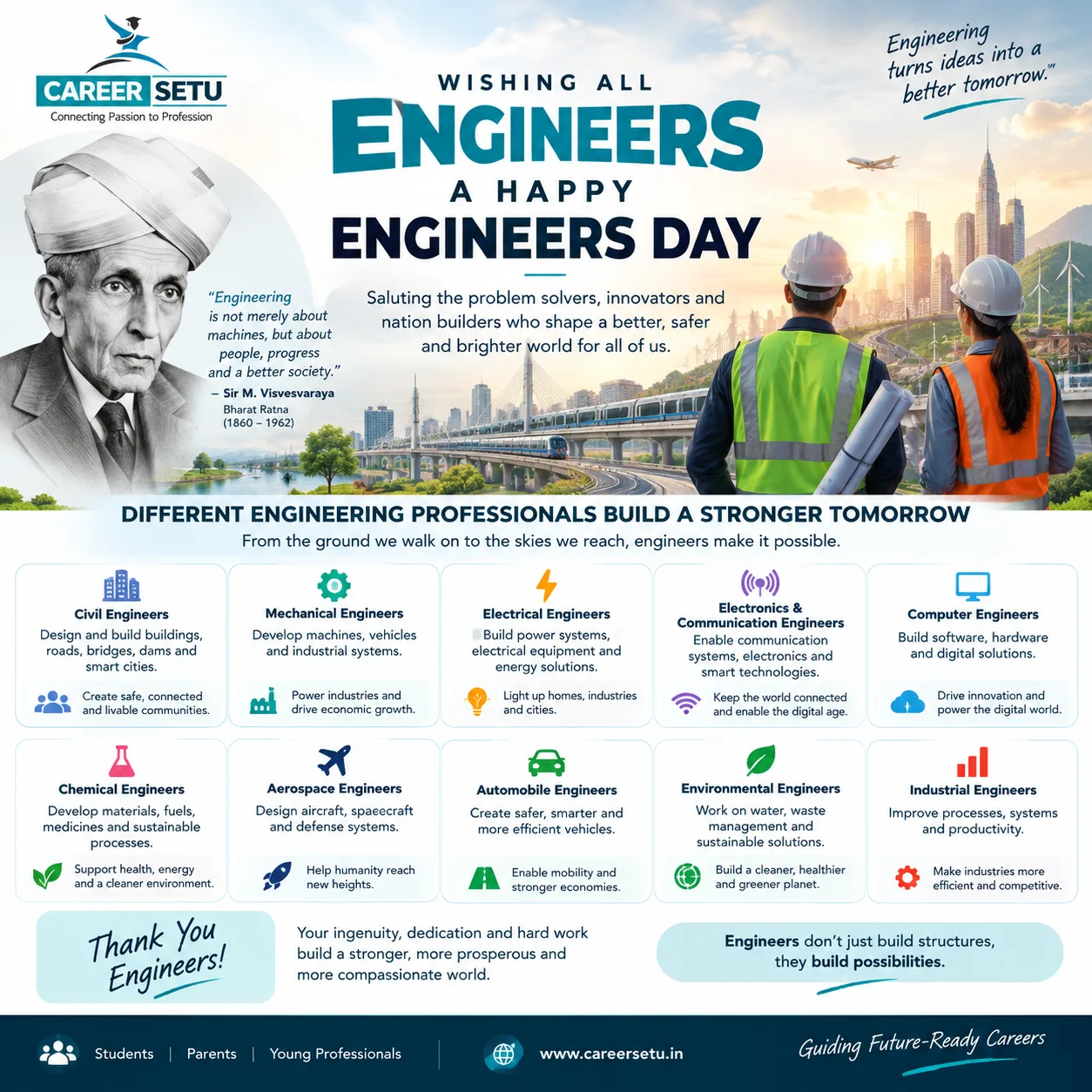
Every year on 15 September, India celebrates Engineers’ Day 🇮🇳 in memory of Sir M. Visvesvaraya, one of India's most respected engineers and nation-builders.
But there is a bigger question worth asking:
🤔 What does engineering actually mean?
Is engineering only about building bridges, designing machines or writing software?
Not really.
Engineering is much bigger.
It is one of the most powerful forces behind human development, technological progress and the way modern civilisation works today.
🧠 What Does Engineering Really Mean?
At its simplest, engineering is the process of using knowledge, science, mathematics, creativity and technology to solve real-world problems.
Engineering brings together:
🔬 Science + 📐 Mathematics + 🎨 Design + 💻 Technology + 🧩 Problem-Solving
A scientist may discover how something works.
An engineer asks:
💭 "How can we use this knowledge to solve a real problem?"
That difference is important.
Engineering takes ideas and turns them into things that people can actually use.
🏗️ A bridge
📱 A smartphone
🚗 An electric vehicle
🏥 A medical device
🛰️ A satellite
⚡ A power system
🤖 An AI system
💧 A water-treatment plant
All of these are examples of engineering turning:
Knowledge → Ideas → Solutions → Impact
🌍 Engineering and the Story of Human Progress
Engineering did not begin with computers.
It began when humans started asking questions:
❓ How can I make this task easier?
❓ How can I travel farther?
❓ How can I grow more food?
❓ How can I get clean water?
❓ How can I build safer shelters?
❓ How can I communicate over long distances?
The solutions to these problems gradually transformed human civilisation.
🕰️ The journey looked something like this:
🧩 Problem
⬇️
💡 Idea
⬇️
⚙️ Engineering
⬇️
🔧 Solution
⬇️
🌍 Human Progress
Early humans developed tools.
The wheel 🛞 changed transportation.
Agricultural and irrigation systems 🌾💧 improved food production.
Buildings and infrastructure 🏛️ allowed communities to grow.
Ships 🚢 enabled long-distance travel and trade.
Machines ⚙️ transformed manufacturing.
Electricity ⚡ transformed homes and industries.
Computers 💻 transformed information processing.
The internet 🌐 transformed communication.
And today, technologies such as Artificial Intelligence 🤖, robotics, biotechnology 🧬, quantum technologies ⚛️ and space systems 🚀 are opening another chapter.
🌟 Engineering has continuously helped humans move from survival to civilisation, and from civilisation to a technological society.
🏗️ Engineering Helped Humans Move From Survival to Civilization
Think about some of the basic things that make modern life possible.
🏠 Shelter
Engineering helped humans create stronger, safer and more complex structures.
💧 Water
Civil engineering has enabled dams, reservoirs, pipelines, drainage systems and water-treatment infrastructure.
🌾 Food
Engineering has transformed agriculture through irrigation, machinery, automation, sensors and data.
🚗 Transportation
From roads and railways to aircraft, ships, electric vehicles and autonomous systems, engineering has continuously expanded human mobility.
⚡ Energy
Engineering has enabled us to generate, transmit, store and increasingly optimise energy.
📡 Communication
Telecommunication, computers, satellites and the internet have connected billions of people.
🏥 Healthcare
Medical engineering has contributed to diagnostic equipment, imaging systems, prosthetics, medical devices and increasingly sophisticated healthcare technologies.
🚀 Space
Engineering has taken human technology beyond Earth through satellites, launch systems, spacecraft and exploration missions.
🌍 This is why engineering is not simply a profession.
Engineering is part of the story of human development.
🌐 Engineering Is Everywhere
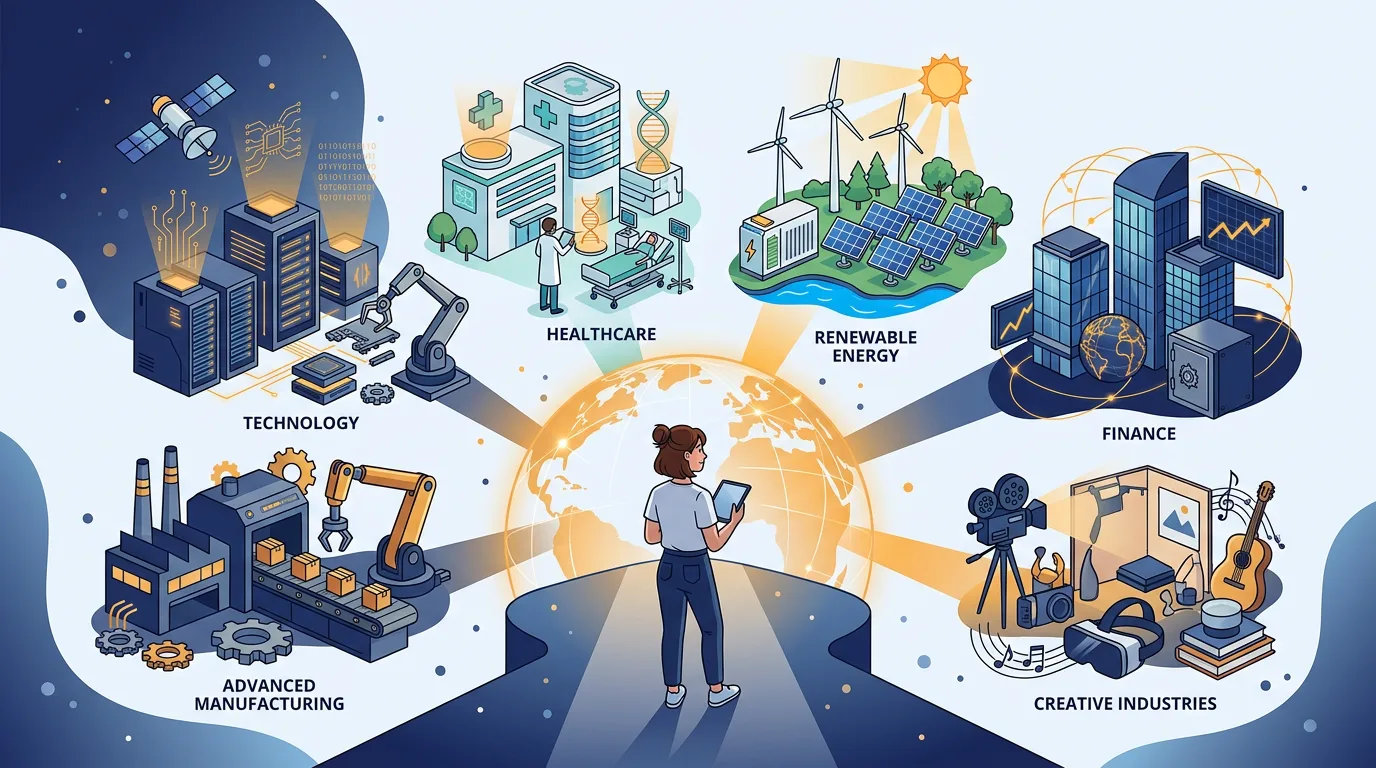
One of the most interesting things about engineering is that it does not belong to just one industry.
Almost every modern industry depends on engineering.
| 🌍 Industry | ⚙️ How Engineering Helps |
|---|---|
| 🏗️ Construction | Buildings, bridges, roads and infrastructure |
| 🚗 Automotive | Vehicles, EVs and autonomous mobility |
| 🏥 Healthcare | Medical devices, diagnostics and healthcare technology |
| 💻 Technology | Software, computing, AI and digital systems |
| ⚡ Energy | Power generation, grids, batteries and renewable energy |
| 🚀 Space | Satellites, spacecraft and launch systems |
| 🌾 Agriculture | Irrigation, automation, sensors and smart farming |
| 🏭 Manufacturing | Machines, robotics, automation and production systems |
| 🌱 Environment | Waste management, pollution control and sustainability |
| 🏦 Finance | Financial technology, digital systems and cybersecurity |
| 🧬 Biotechnology | Biological processes, medical technologies and biomanufacturing |
| 🌊 Water | Treatment, distribution, conservation and infrastructure |
🔑 The big idea:
Engineering is an enabler of almost every modern industry.
🛠️ Engineering Is More Than Machines
When people hear the word "engineering", they often imagine machines, factories or construction sites.
But modern engineering has expanded far beyond that.
📐 Mathematics + Problem-Solving
Can lead to:
- 🏗️ Civil Engineering
- ⚙️ Mechanical Engineering
- ⚡ Electrical Engineering
- 🚀 Aerospace Engineering
💻 Computers + Logic
Can lead to:
- 💻 Computer Engineering
- 👨💻 Software Engineering
- 🤖 Artificial Intelligence
- 🧠 Machine Learning
- 🔐 Cybersecurity
🧬 Biology + Technology
Can lead to:
- 🏥 Biomedical Engineering
- 🧬 Biotechnology
- 🧪 Bioengineering
- 🩺 Medical Technology
🌱 Environment + Technology
Can lead to:
- 🌍 Environmental Engineering
- ☀️ Renewable Energy Engineering
- ♻️ Sustainability Engineering
- 🔋 Energy Systems
⚛️ Physics + Advanced Technology
Can lead to:
- 📡 Electronics Engineering
- 💾 Semiconductor Engineering
- ⚛️ Quantum Engineering
- 🔦 Photonics
🔄 This is why the future of engineering is becoming increasingly interdisciplinary.
🤝 The Future Is Being Built by Multiple Engineering Disciplines
Some of the world's most important technologies cannot be developed by one engineering branch alone.
🚗 Consider an Electric Vehicle
An EV may involve:
⚙️ Mechanical Engineering + ⚡ Electrical Engineering + 🔌 Electronics + 🔋 Battery Technology + 💻 Software + 🤖 AI
🏙️ Consider a Smart City
It can involve:
🏗️ Civil Engineering + ⚡ Electrical Engineering + 📡 IoT + 📊 Data + 🤖 AI + 🌱 Environmental Engineering
🏥 Consider a Medical Robot
It may involve:
⚙️ Mechanical Engineering + 🔌 Electronics + 💻 Software + 🤖 AI + 🧬 Biomedical Engineering
🚀 Consider a Spacecraft
It may require:
🚀 Aerospace + 📡 Electronics + 🧱 Materials + 💻 Software + 🎛️ Control Systems + 🤖 AI
💡 The engineering problems of tomorrow will increasingly require engineers who can work across disciplines.
🔮 Emerging Engineering Sectors
Technology is creating new engineering opportunities beyond the traditional branches.
Here are some areas students should watch closely.
🤖 1. Artificial Intelligence & Machine Learning
AI is changing how organisations work, make decisions and build products.
Engineering opportunities are growing around:
- 🤖 Machine Learning
- 🧠 AI Systems
- ✨ Generative AI
- 👁️ Computer Vision
- 🦾 Robotics
- ⚙️ Intelligent Automation
- 💻 AI Infrastructure
🚀 The future engineer may not simply build software. They may build intelligent systems.
💾 2. Semiconductor & Electronics Engineering
Almost every modern digital product depends on semiconductor technology.
From smartphones and computers to electric vehicles, medical equipment and defence systems, chips are at the centre of modern technology.
Emerging opportunities include:
- 💾 Semiconductor Design
- 🔬 VLSI
- 🧠 Chip Architecture
- 🔌 Embedded Systems
- 📡 Electronics
- 💻 Hardware Engineering
- 🏭 Semiconductor Manufacturing
🦾 3. Robotics & Autonomous Systems
Robots are moving beyond factories.
They are increasingly being explored for:
- 🏥 Healthcare
- 🏭 Manufacturing
- 📦 Logistics
- 🌾 Agriculture
- 🛡️ Defence
- 🚀 Space
- 🚗 Autonomous Mobility
This field brings together:
⚙️ Mechanical Engineering + 🔌 Electronics + 💻 Software + 🤖 AI + 🎛️ Control Systems
☀️ 4. Renewable Energy & Energy Storage
The transition towards cleaner energy is creating new engineering challenges.
Engineers are working on:
- ☀️ Solar Energy
- 🌬️ Wind Energy
- 🔋 Battery Technology
- 🔌 Energy Storage
- ⚡ Smart Grids
- 💧 Hydrogen
- 📊 Energy Management
The challenge is no longer simply generating energy.
It is also about storing, distributing and using energy efficiently.
🚘 5. Electric Vehicles & Future Mobility
Transportation is undergoing a major transformation.
Future mobility can involve:
- 🔋 Electric Vehicles
- 🤖 Autonomous Vehicles
- 🔋 Battery Systems
- 💻 Vehicle Software
- 📡 Connected Vehicles
- 🏙️ Mobility Infrastructure
- 🚦 Intelligent Transportation Systems
🚘 The automobile is increasingly becoming a combination of mechanical engineering, electronics, software and AI.
🛰️ 6. Space Engineering
Space technology is opening new possibilities in:
- 🛰️ Satellite Systems
- 🚀 Launch Vehicles
- 🛸 Spacecraft
- 🌍 Earth Observation
- 📡 Navigation
- 🤖 Space Robotics
- 📶 Space Communications
The future of space engineering is not limited to government space programmes.
It is increasingly connected to communication, climate monitoring, agriculture, navigation and commercial applications.
⚛️ 7. Quantum Engineering
Quantum technologies are emerging at the intersection of physics, engineering and computing.
Potential applications include:
- 🖥️ Quantum Computing
- 🔐 Quantum Communication
- 📡 Quantum Sensors
- 🧱 Advanced Materials
- 🔒 Secure Communication
This is an emerging field where students with strong foundations in physics, mathematics, electronics and computing may find future opportunities.
🧬 8. Biomedical & Biotechnology Engineering
The boundaries between engineering and biology are becoming increasingly connected.
Emerging applications include:
- 🏥 Medical Devices
- 🔬 Diagnostic Technologies
- 🦿 Prosthetics
- 🧬 Biomedical Systems
- 🧪 Bioengineering
- 🏭 Biomanufacturing
- 🤖 Healthcare Robotics
🧬 Engineering is increasingly helping us not only build machines, but also solve problems related to the human body and biological systems.
🔐 9. Cybersecurity & Cyber-Physical Systems
As physical infrastructure becomes digitally connected, protecting those systems becomes increasingly important.
Examples include:
- ⚡ Smart Grids
- 🏭 Industrial Systems
- 🚗 Connected Vehicles
- 🏥 Healthcare Systems
- 📡 IoT Devices
- 🏙️ Critical Infrastructure
This creates demand for engineers who understand both:
💻 Technology + 🔐 Security
🌱 10. Climate & Environmental Engineering
Climate challenges are creating new engineering problems.
Engineers are increasingly involved in:
- ☀️ Clean Energy
- 💧 Water Management
- ♻️ Waste Management
- 🌍 Carbon Reduction
- 🏙️ Sustainable Infrastructure
- 📊 Environmental Monitoring
- 🔄 Circular Economy
The engineer of the future will increasingly have to think about not only:
"Can we build it?"
but also:
🌱 "Can we build it sustainably?"
🧠 What Skills Will the Future Engineer Need?
A degree alone may not be enough for the engineering careers of tomorrow.
Students should develop a combination of technical and human skills.
🛠️ Core Skills
- 🧩 Problem-Solving
- 📊 Analytical Thinking
- 📐 Mathematics
- 💻 Digital Literacy
- 📈 Data Literacy
- 🤖 AI Literacy
- 🎨 Creativity
- 🗣️ Communication
- 🤝 Teamwork
- 🌐 Systems Thinking
- 🔄 Adaptability
- 📚 Lifelong Learning
💡 The future engineer will need to be more than a technical specialist.
They will need to be a problem solver.
🎯 Is Engineering Still a Good Career Choice?
Yes.
But there is an important shift.
Choosing engineering only because:
💰 "Engineering has a good salary."
or
👥 "Everyone is doing engineering."
is not a strong reason.
A better question is:
🤔 "What kind of problems do I enjoy solving?"
⚙️ If you enjoy Machines & Physical Systems
Explore:
- Mechanical Engineering
- Automobile Engineering
- Robotics
- Aerospace
🏗️ If you enjoy Buildings & Infrastructure
Explore:
- Civil Engineering
- Structural Engineering
- Environmental Engineering
⚡ If you enjoy Electricity & Electronics
Explore:
- Electrical Engineering
- Electronics
- Semiconductor Technology
- Embedded Systems
💻 If you enjoy Computers & Technology
Explore:
- Computer Engineering
- Software
- AI & Machine Learning
- Cybersecurity
🧬 If you enjoy Biology & Healthcare
Explore:
- Biomedical Engineering
- Biotechnology
- Bioengineering
🚀 If you enjoy Space & Advanced Technology
Explore:
- Aerospace
- Electronics
- Materials
- Robotics
- Space Technology
🎯 Your interests can provide clues about which engineering pathway may suit you.
🔄 Engineering Is Becoming Interdisciplinary
One of the biggest changes in engineering is the disappearance of strict boundaries between disciplines.
The future may not be about being only a:
Mechanical Engineer
or only an:
Electrical Engineer
Instead, engineers may increasingly work at the intersection of multiple domains.
For example:
🤖 Mechanical + Electronics + AI = Robotics
🚘 Electrical + Electronics + Software = Smart Mobility
🏙️ Civil + IoT + Data + AI = Smart Infrastructure
🧬 Biology + Engineering + Computing = Advanced Healthcare
⚛️ Physics + Computing + Electronics = Quantum Technology
🔑 The lesson for students:
Don't only think about:
"Which branch should I choose?"
Also think about:
"Which combination of skills can help me solve meaningful problems?"
💡 What Does Engineering Really Mean?
After everything we have discussed, engineering can be understood in one simple way:
🧠 Engineering is the ability to turn knowledge into solutions that improve human life.
It is about:
👀 See a Problem
⬇️
🧠 Understand It
⬇️
💡 Imagine a Solution
⬇️
📐 Design It
⬇️
🔧 Build It
⬇️
🧪 Test It
⬇️
🔄 Improve It
⬇️
🌍 Create Impact
⚙️ That is the engineering mindset.
🎓 A Message for Students on Engineers' Day
If you are a student thinking about engineering, don't start with:
❌ "Which engineering branch has the highest salary?"
Start with:
✅ "What kind of problems do I want to solve?"
Do you want to:
🏙️ Build cities?
⚙️ Design machines?
🤖 Create intelligent systems?
🏥 Develop medical technologies?
🔐 Protect digital infrastructure?
🌱 Work on clean energy?
🚀 Explore space?
🚘 Build the next generation of vehicles?
🌍 Develop sustainable solutions?
Your answer can help you explore the right engineering pathways.
Because engineering is not just about choosing a branch.
🎯 It is about choosing the kind of problems you want to spend your life solving.
🇮🇳 Engineers' Day 2026: A Tribute to the Engineering Mindset
India celebrates Engineers' Day on 15 September in memory of Sir M. Visvesvaraya, whose work in engineering and infrastructure contributed significantly to India's development.
His legacy reminds us that engineering is ultimately about using knowledge and capability for public progress.
Today, the problems may look different.
But the engineering mindset remains the same:
🧩 Problem
🧠 Understand
💡 Imagine
🔧 Build
🧪 Test
🔄 Improve
🌍 Impact
From:
💧 Irrigation systems → 🤖 Artificial Intelligence
🏗️ Bridges → 🚀 Spacecraft
⚡ Electricity → ⚛️ Quantum Technology
⚙️ Machines → 🧠 Intelligent Systems
🌟 Engineering continues to expand what humans are capable of achieving.
🌍 The Future Needs Engineers Who Solve Meaningful Problems
The next generation of engineers will work on some of humanity's biggest challenges:
❓ How do we build sustainable cities?
❓ How do we provide clean energy?
❓ How do we improve healthcare?
❓ How do we make transportation smarter?
❓ How do we protect digital infrastructure?
❓ How do we use AI responsibly?
❓ How do we explore space?
❓ How do we build technology without harming the planet?
These are not just technology questions.
❤️ They are human questions.
And engineering will be one of the tools we use to answer them.
🎯 CareerSetu Perspective
At CareerSetu, we believe that choosing a career should begin with understanding yourself.
Engineering has hundreds of possible pathways, and the right choice depends on more than marks.
Consider your:
🧠 Personality
❤️ Interests
💪 Strengths
🎯 Abilities
📚 Learning Style
🚀 Career Goals
🌍 Future Opportunities
💡 The goal is not to find the "best" engineering branch for everyone.
The goal is to discover the engineering pathway that fits YOU.
❓ Frequently Asked Questions
What is engineering in simple words?
Engineering is the application of science, mathematics, technology and creativity to design solutions for real-world problems.
🌍 Why is engineering important?
Engineering helps create infrastructure, technology, transportation, healthcare systems, energy solutions, communication systems and many other things that support modern life.
⚙️ Is engineering only about machines?
No. Modern engineering includes software, AI, biotechnology, healthcare, environmental systems, cybersecurity, semiconductors, space technology and many other areas.
🔮 Which engineering fields are emerging?
Some emerging areas include:
- 🤖 AI & Machine Learning
- 💾 Semiconductor Technology
- 🦾 Robotics
- ☀️ Renewable Energy
- 🚘 Electric Mobility
- 🚀 Space Engineering
- ⚛️ Quantum Engineering
- 🧬 Biomedical Engineering
- 🔐 Cybersecurity
- 🌱 Environmental Engineering
🧠 What skills should future engineers develop?
Future engineers should build problem-solving, analytical thinking, creativity, communication, AI and digital literacy, systems thinking, teamwork and adaptability.
💰 Should I choose engineering because it offers a good salary?
Salary is one factor, but it should not be the only reason.
Your interests, abilities, strengths, learning preferences and long-term career goals should also be considered.
🇮🇳 Happy Engineers' Day!
To every engineer who designs, builds, solves, improves and innovates — thank you for helping move humanity forward.
And to every student dreaming of becoming an engineer:
💭 Don't just ask what you can build.
🎯 Ask what problem you can solve.
Because the future belongs to engineers who don't just build things.
🚀 It belongs to engineers who build a better future.
🌉 CareerSetu
Connecting Passion to Profession
🎯 Explore Engineering Career Options
🧠 Take a Career Assessment
Discover your interests. Understand your strengths. Explore careers that fit you.
The Journey of Engineering: From Tools to AI
- Ancient EraEarly humans developed basic tools for survival.
- Early CivilisationThe invention of the wheel changed transportation forever.
- Agricultural EraIrrigation and agricultural systems improved food production.
- Infrastructure DevelopmentBuildings and infrastructure allowed communities to grow.
- Industrial EraMachines and manufacturing transformed how we make things.
- Electrical EraElectricity transformed homes and global industries.
- Digital RevolutionComputers changed how humans process information.
- Information AgeThe internet transformed global communication.
- The FutureAI, Robotics, and Space systems open a new chapter.
The Engineering Lifecycle
- 1
Phase 1
Problem
Identifying a human need or a gap in current capabilities.
- 2
Phase 2
Idea
Using creativity and scientific knowledge to conceptualize a fix.
- 3
Phase 3
Engineering
Applying math, design, and technology to build a prototype.
- 4
Phase 4
Solution
A functional product or system ready for real-world use.
- 5
Phase 5
Progress
Societal growth and improved quality of life.
Interdisciplinary Engineering Careers
Electric Vehicle (EV) Engineering
Skills: Battery Tech, Control Systems, Autonomous Logic
Pathway: Mechanical + Electrical + Electronics + Software + AI
Smart City Infrastructure
Skills: Urban Planning, Connectivity, Sustainability
Pathway: Civil + Electrical + IoT + Data + AI + Environmental
Medical Robotics
Skills: Surgical Precision, Diagnostic Logic, Bio-interface
Pathway: Mechanical + Electronics + Software + AI + Biomedical
Spacecraft Engineering
Skills: Launch Systems, Propulsion, Satellite Comm
Pathway: Aerospace + Electronics + Materials + Control Systems + AI
Engineering Specializations & Modern Industry Fit
- Civil Engineering95% fit
Focuses on infrastructure like buildings, bridges, and water systems.
- Mechanical Engineering90% fit
Involved in machines, manufacturing, and automotive systems.
- Computer Engineering/AI98% fit
Deals with software, intelligent systems, and digital logic.
- Biomedical Engineering/Biotech Engineering85% fit
Combines biology and technology for healthcare and medical devices.
- Aerospace Engineering/Space Systems88% fit
Focused on satellites, spacecraft, and launch systems.
- Electronics/Semiconductor Engineering Engineering92% fit
Critical for hardware, chips, and embedded systems.
Engineering Basics FAQ
Common Questions About Engineering Careers
Is engineering only about machines?
What skills should future engineers develop?
Should I choose engineering because it offers a good salary?
Keep reading
More guides on the same topic.